DWDM transceivers with a fixed wavelength are ideally suited for operation within the band of a specific wavelength. They are preferably used in static networks in which no changes are expected in the future.
The wavelength of a Tunable DWDM transceiver, on the other hand, can be set individually. These flexibly deployable transceiver modules are primarily aimed at carriers, ISPs and data center operators - in other words, at customers whose networks have a certain dynamism and are expected to grow further in the future.
Consider, for example, an SFP+ transceiver: the main difference between fixed wavelength transceivers and Tunable transceivers is that the wavelength of DWDM SFP+ transceivers is fixed and unchangeable, while the Tunable SFP+ variant can adjust its wavelength on site to the desired lambda.
Tunable DWDM SFP+ transceivers allow the wavelength to be changed indefinitely within the C-band DWDM ITU grid and can be used in various types of equipment such as switches, routers, servers and in DWDM systems.
It uses all possible bands (from 1260nm to 1625nm), spacing each channel 20nm, with a total of 18 channels, typically manufacturers produce CWDM devices with a reach between 50km to 80km but with the use of amplifiers can reach up to 160kms.
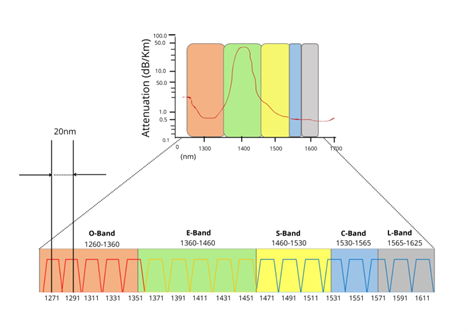
Coarse Wavelength Division Multiplexing (CWDM), a WDM technology, is characterized by wider channel spacing than Dense WDM (DWDM) as defined in ITU-T Rec. G.671. CWDM systems can realize cost-effective applications, through a combination of uncooled lasers, relaxed laser wavelength selection tolerances and wide passband filters. CWDM systems can be used in transport networks in metropolitan areas for a variety of clients, services and protocols.
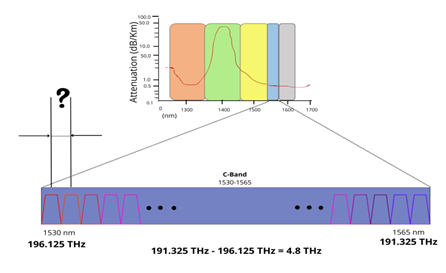
It uses the C band, with the best performance in the attenuation spectrum, to indicate that we are talking about DWDM instead of CWDM we are going to be talking in THz instead on nanometers, the C band uses the frequencies between 191.325 THz – 196.125 THz that gave us 4.8 THz to insert our channels, DWDM also has a difference with CWDM, don’t segment the working spectrum in a fixed grill, DWDM allow the manufacturers to segment the spectrum according to the technological level that they are capable to produce, allowing to use the spectrum in a more efficient way as technology improves.
As defined in [ITU-T G.671], dense wavelength division multiplexing (DWDM), a wavelength division multiplexing (WDM) technology, is characterized by narrower channel spacing than coarse WDM (CWDM). In general, the transmitters employed in DWDM applications require a control mechanism to enable them to meet the application's frequency stability requirements, in contrast to CWDM transmitters, which are generally uncontrolled in this respect. The frequency grid defined by this Recommendation supports a variety of fixed channel spacings ranging from 12.5 GHz to 100 GHz and wider (integer multiples of 100 GHz) as well as a flexible grid. Uneven channel spacings using the fixed grids are also allowed. The current steps in channel spacing for the fixed grids have historically evolved by sub-dividing the initial 100 GHz grid by successive factors of two.