
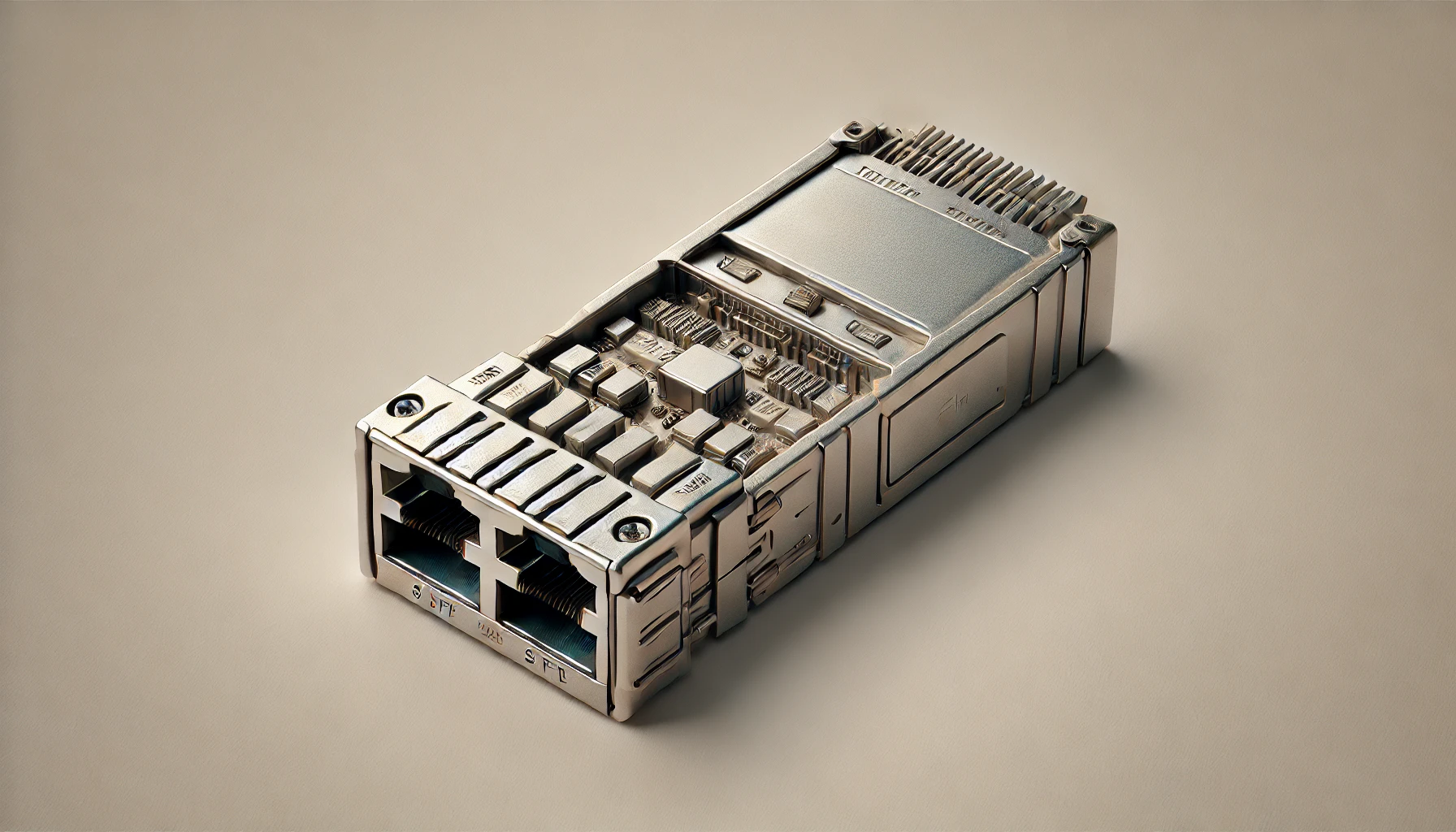
SFP modules provide networks the ability to convert Ethernet signals to fiber optic signals without having to change the networking switch or router. It saves the customers the need to replace or upgrade any networking or cabling infrastructure. SFP modules have the ability to transfer data over short as well as long distances with faster data transmission speeds. It is compatible with both copper and fiber optic cables.
SFP modules due to their “hot swappable” and pluggable features offer easy integration with existing networks.
SFP modules can operate over both Optical Fiber and Ethernet Cables, leading to the two main types: Fiber SFP and Copper SFP.
• Fiber SFP: These user fiber optic cables for data transmission.
• Cooper SFP: These use cooper cables for data transmission and are typically used for short-range connections.
The Ethernet copper-based SFP modules are 1000BASE-T and 1000BASE-TX. They are used in gigabit Ethernet networking for a range within and up to 100 meters and use a copper RJ45 interface. The copper-based SFP modules operate on CAT 5 UTP cable with lengths up to 100m distances. The below list contains examples of SFPs configurations:
| Type | Speed | Media | Wavelength | Distance | Connector | Case Temperature |
|---|---|---|---|---|---|---|
| SFP SerDes | 1,25 Gbps | Copper | 100m | RJ-45 | -40° a +85°C | |
| SFP SGMII | 1,25 Mbps | Copper | 100m | RJ-45 | 0° a 70°C | |
| SFP SGMII | 10/100/1000 Mbps | Copper | 100m | RJ-45 | -40° a +85°C | |
| SFP | 1,25 Gbps | MMF | 850 nm | 550 m | LC Duplex | -40° a +85°C |
| SFP | 155 Mbps | MMF | 850 nm | 2 km | LC Duplex | -40° a +85°C |
| SFP | 155 Mbps | MMF | 1300 nm | 2 km | LC Duplex | -40° a +85°C |
| SFP | 1,25 Gbps | MMF | 1300 nm | 2 km | LC Duplex | 0° a 70°C |
| SFP | 1,25 Gbps | SMF | 1310 nm | 10 km | LC Duplex | -40° a +85°C |
| SFP | 1,25 Mbps | SMF | 1550nm TX, 1310nm RX | 10 km | LC Simplex | -40° a +85°C |
| SFP | 1,25 Mbps | SMF | 1310nm TX, 1550nm RX | 10 km | LC Simplex | -40° a +85°C |
| SFP | 1,25 Gbps | SMF | 1310 nm | 20 km | LC Duplex | -40° a +85°C |
| SFP | 155 Mbps | SMF | 1310 nm | 30 km | LC Duplex | -40° a +85°C |
| SFP | 1,25 Gbps | SMF | 1310 nm | 40 km | LC Duplex | -40° a +85°C |
| SFP | 155 Mbps | SMF | 1310 nm | 60 km | LC Duplex | 0° a 70°C |
| SFP | 1,25 Mbps | SMF | 1550 nm | 80 km | LC Duplex | -40° a +85°C |
BiDi or bi-directional transmission relies on transceivers that have two different wavelengths in order to accommodate transmission in both directions on just one fiber. Unlike conventional optical transceivers which have two ports, BiDi transceivers only have one.