
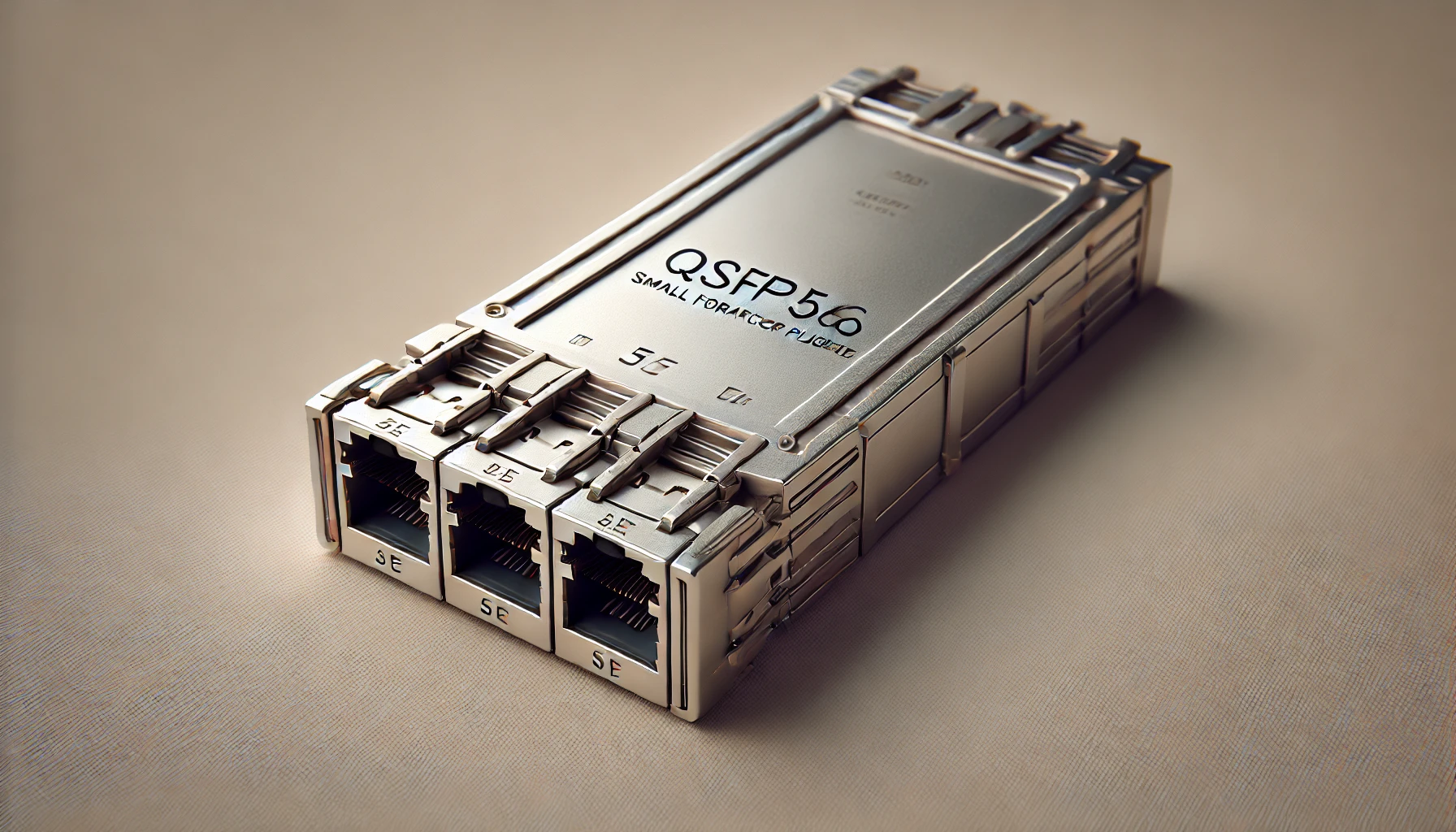
The QSFP56 (Quad Small Form-Factor Pluggable 56) Optical Transceiver is a module designed to support high-speed communication networks. The ’56’ in its name signifies the data rate per channel, showcasing its ability to transmit data at 56 Gigabits per second. Its functionality converts electrical signals into optical signals, allowing for efficient, high-speed data transmission over fiber optic cables. The versatility of the 200G QSFP56 lies in its capability to support different network standards, including 200GBASE Ethernet and 2x InfiniBand HDR. With this flexibility, networks can be upgraded or extended without a complete system overhaul, providing a future-proof solution that keeps pace with advancing technology.
| Type | Speed | Media | Wavelength | Distance | Connector | Case Temperature |
|---|---|---|---|---|---|---|
| QSFP 56 | 200Gbps | Duplex SMF | 850nm | 100m | MPO-12 | 70° |
| QSFP 56 | 200Gbps | Duplex SMF | 1310nm | 500m | LC | 70° |
The Optical Transmission process in 200G QSFP56 Optical Transceivers is a fascinating interplay of optics and electronics. It begins with converting electrical signals into light pulses via a laser or light-emitting diode (LED). These light pulses are transmitted through fiber optic cables at incredible speeds, reaching up to 56 gigabits per second per channel. The receiving end of the transmission line houses a photodetector, which converts these light signals back into electrical ones. This entire process happens in a matter of nanoseconds, thereby offering lightning-fast data transmission. The QSFP56 transceivers ensure optimal signal integrity throughout the transmission path, thanks to advanced techniques like Forward Error Correction (FEC) and high-performance amplifiers. With such state-of-the-art technology, the 200G QSFP56 Optical Transceivers are the epitome of high-speed, reliable, and efficient data transmission in modern networking applications.