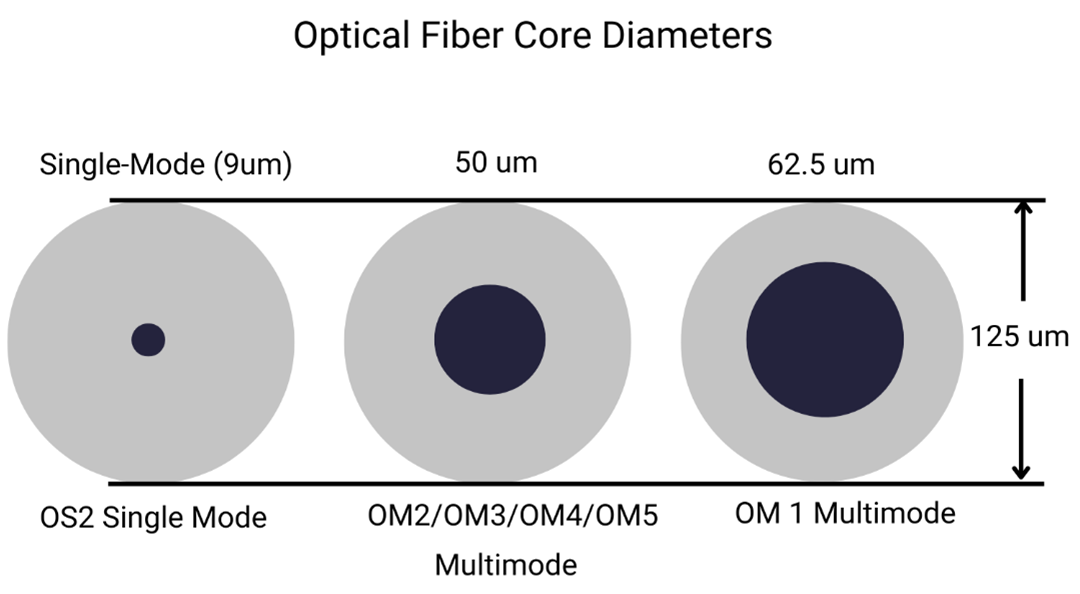
Multimode means the fiber can propagate multiple modes. The multimode fiber has a core diameter of 50 microns and 62.5 microns, and cladding diameter of 125 microns, the MMF is designated to operate at 850nm and 1300nm. Common multimode SFPs work at a wavelength of 850 nanometers and is used for short-distance transmission, reaching distances of 100 meters - 550 meters, typical applications are datacenters or buildings. Inside MMF happens due its large core, some of the light rays that make up the digital pulse may travel a direct route, whereas others zigzag as they bounce off the cladding. These alternate paths cause the different group of light rays referred as modes, to arrive separately at the receiving point. The pulse, an aggregate of different modes, begins to spread out, losing its well-defined shape. The need to leave spacing between pulses to prevent overlapping limits the amount of information that can be sent.
Single Mode means the fiber enables one type of light mode to be propagated at a time. Because of this, the number of light reflections created as the light passes through the core decreases, lowering attenuation and creating the ability for the signal to travel further. This application is typically used in long distance, higher bandwidth runs by Telcos, CATV companies, Colleges and Universities.
The differences between SMF and MMF optic cable mainly lie in fiber core diameter, wavelength, light source, bandwidth, color sheath, distance and cost. Generally, SMF should be used over long distances (greater than 500m), whereas MMF should be used over short distances (less tan 500m).
The reason being: The larger core diameter in MMF allows for a greater number of signals/rays of light to travel through at a time.